Religious Education
To Know You More Clearly
At St Mary’s, Religious Education is at the heart of our curriculum and our Catholic identity.
We follow the new Religious Education Directory (RED), To Know You More Clearly, which provides the curriculum for Religious Education in Catholic schools in England and Wales.
The purpose of our RE curriculum is not simply for children to learn facts about our faith. We want our children to know God more clearly, encounter Scripture, deepen their understanding of the Catholic faith and recognise how faith can shape the way we live our lives.
Our Six Branches
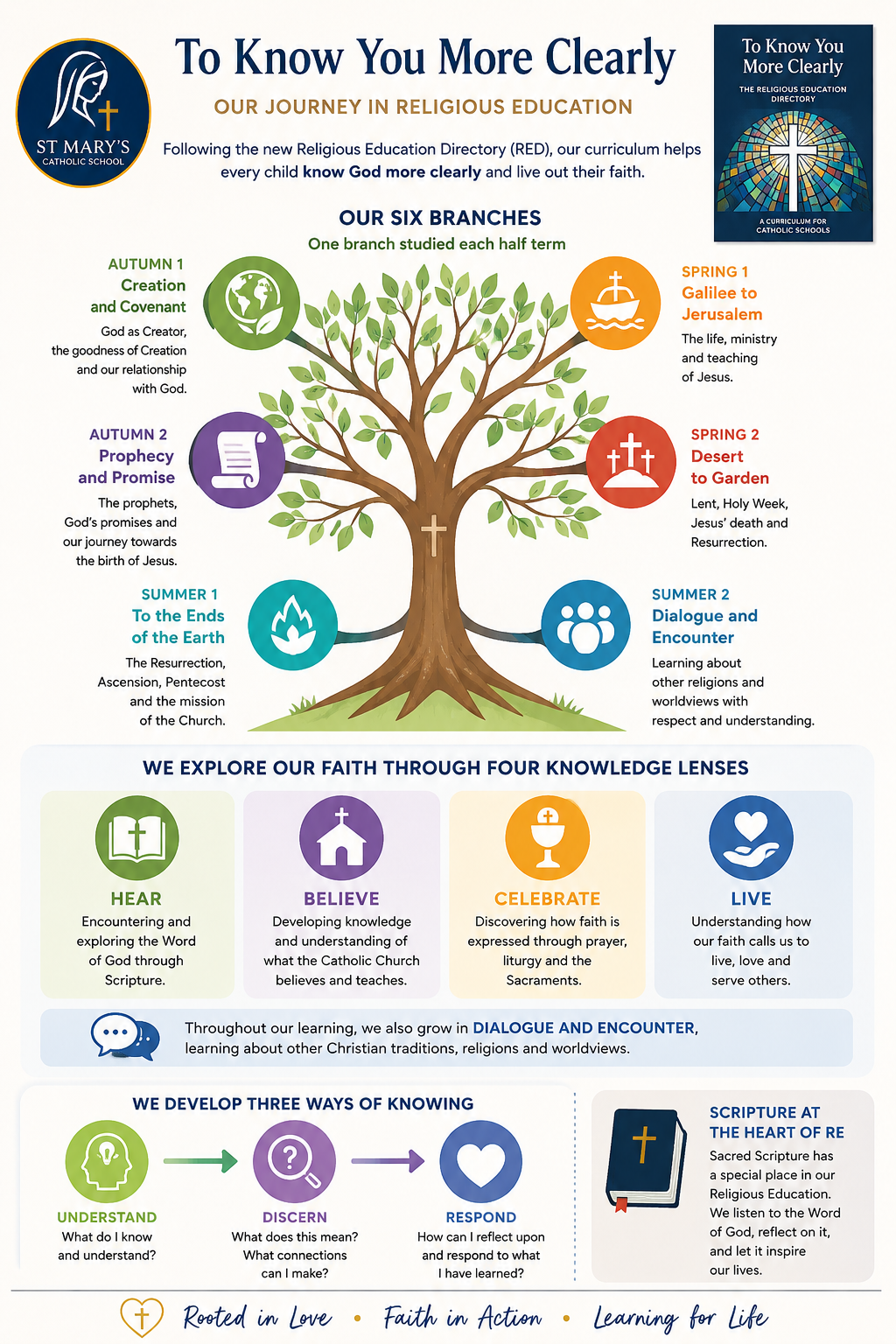
Our Religious Education curriculum is organised into six branches, with one studied during each half term:
Autumn 1 – Creation and Covenant
God as Creator, the goodness of Creation and our relationship with God.
Autumn 2 – Prophecy and Promise
The prophets, God's promises and our journey towards the birth of Jesus.
Spring 1 – Galilee to Jerusalem
The life, ministry and teaching of Jesus.
Spring 2 – Desert to Garden
Lent, Holy Week, Jesus' death and Resurrection.
Summer 1 – To the Ends of the Earth
The Resurrection, Ascension, Pentecost and the mission of the Church.
Summer 2 – Dialogue and Encounter
Learning about Christianity alongside respectful dialogue and encounter with other religions and worldviews.
Children return to these branches as they move through school, building upon previous learning and encountering Scripture and Catholic teaching with increasing depth and understanding.
How Do Children Explore Their Faith?
Within the branches, children explore their learning through Knowledge Lenses:
HEAR
Encountering and exploring the Word of God through Scripture.
BELIEVE
Developing knowledge and understanding of what the Catholic Church believes and teaches.
CELEBRATE
Discovering how faith is expressed through prayer, liturgy and the Sacraments.
LIVE
Understanding how our faith calls us to live, love and serve others.
Children will also develop their understanding through Dialogue and Encounter, learning about other Christian traditions, religions and worldviews.
How Do We Know What Children Have Learned?
Throughout their RE learning, children develop three Ways of Knowing:
UNDERSTAND
What do I know and understand?
DISCERN
What does this mean? What connections can I make?
RESPOND
How can I reflect upon and respond to what I have learned?
These help children to move beyond simply remembering information. We want them to think deeply, ask questions, make connections, use religious vocabulary confidently and understand the relationship between faith and everyday life.
Scripture at the Heart of RE
Sacred Scripture has a special place within our Religious Education.
Children regularly encounter Scripture directly from the Bible and are encouraged to listen, wonder, question, reflect and respond to the Word of God.
From the wonder and awe of our youngest children in EYFS to increasingly rich theological thinking as children move through school, our aim remains the same:
To help every child know God more clearly and understand how His love calls us to live.
Rooted in Love – Faith in Action – Learning for Life
Time for Religious Education
As required within Catholic schools, approximately 10% of curriculum teaching time is dedicated to Religious Education.
This is separate from the time given to collective worship, prayer, liturgy, Mass and the wider Catholic life and mission of the school.
RE is taught regularly so that children can build knowledge securely and engage with ideas in appropriate depth.
Teaching and learning
RE lessons may include:
-
Reading and exploring Scripture
-
Studying religious artwork, music and symbolism
-
Using artefacts and other sources
-
Learning and applying theological vocabulary
-
Discussion and carefully structured questioning
-
Written explanations
-
Comparing ideas, beliefs and practices
-
Drama, art and creative responses
-
Making connections with Catholic Social Teaching
-
Exploring how belief influences people’s lives
-
Personal reflection
Children are encouraged to speak thoughtfully, support their ideas with evidence and listen respectfully to the contributions of others.
Assessment
Assessment is an integral part of RE teaching.
Teachers assess children’s knowledge and understanding through their spoken contributions, written work, use of vocabulary and ability to make connections and explain ideas.
Assessment helps teachers to:
-
Identify what children know and remember
-
Recognise misconceptions or gaps
-
Adapt future teaching
-
Provide appropriate support and challenge
-
Evaluate progression through the curriculum
-
Report clearly to parents and carers
Children’s work is considered against the age-related expectations within the RED. Assessment does not judge a child’s personal faith, religious practice or willingness to participate in worship.
Inclusion and SEND
Religious Education is ambitious and accessible for every child.
Teachers use adaptive teaching to remove barriers while preserving the essential knowledge and meaning of the curriculum. Support may include:
-
Pre-teaching important vocabulary
-
Visual prompts and symbols
-
Carefully selected Scripture extracts
-
Practical resources and artefacts
-
Structured discussion
-
Additional modelling
-
Sentence stems and writing scaffolds
-
Opportunities to respond orally, practically or creatively
-
Revisiting and overlearning key concepts
Children with SEND are supported to participate fully and demonstrate what they know in ways suited to their individual strengths and needs.
Other religions and worldviews
The RED is rooted in the teaching of the Catholic Church while also providing structured opportunities for children to learn about other Christian denominations, religions and worldviews.
Through the Dialogue and Encounter branch and wider curriculum opportunities, children develop accurate knowledge, respectful curiosity and an understanding of the religious and cultural diversity of modern Britain and the wider world.
Teaching about other faiths is approached sensitively and authentically. Similarities and differences are explored without presenting different traditions as though they are all the same.
Supporting RE at home
Parents and carers can support children’s RE learning by:
-
Talking about what they have learned
-
Reading Bible stories together
-
Discussing the meaning of religious vocabulary
-
Visiting churches, museums and places of worship
-
Noticing religious art, symbols and architecture
-
Talking about celebrations within the Church’s year
-
Discussing examples of justice, service and care for others
-
Encouraging children to ask questions
-
Sharing family traditions and experiences
-
Using materials and vocabulary shared by school
Families of all faiths and none are encouraged to discuss learning openly and respectfully. Children benefit greatly when they can share questions, ideas and experiences between home and school.
Our curriculum documents
The following documents will be available on this page as the new curriculum is introduced:
-
St Mary’s RE Curriculum Overview
-
RED Branch Overview
-
RE Progression Document
-
Age-Related Expectations
-
Religious Education Policy
-
Guidance for Supporting RE at Home
-
Catholic Education Service Religious Education Directory
These documents will be reviewed as staff implement the RED and evaluate how effectively it meets the needs of our children and mixed-age classes.